Showing posts with label North Carolina Climbing. Show all posts

Tuesday, November 8, 2011

First Trip Up Whitesides

Around this time last fall, I began preparing for a trip to North Carolina the week of Thanksgiving.  I had never been here before but had heard of the great climbing there.  To prepare, I began looking on Mountainproject.com and bought a guide book.  Once the guide book arrived, I would read it constantly.  One place more than others caught my attention and that was Whitesides.  With adjectives such as "most-feared," "biggest and baddest," and "serious aura;" I was lured into studying some of the long and committing routes on its southeast face.  Upon going through ever route in the guidebook I noticed one thing, this stuff is hard. With the easiest route going free at 5.11a or 5.10c/A0, it would not be an easy task to make it up this wall.  Over the course of the month of November, I prepared for a possible encounter with this massive wall of rock.  Those plans never went through.  Due to a poor looking forecast and my trip partner not sure if he could go, I cancelled the trip and went to Arkansas for the week.

Once I moved to North Carolina, the thought of going to Whitesides scared me.  I had experienced some climbs here in NC that pushed me to physical and mental limits and they were supposed to be easier than the easiest route at Whitesides.  How was I ever going to do it?

This past August, I was shadowing a course with one of the adjunct guides here, Todd.  Todd wanted me to take him up the Original Route at Whitesides.  I agreed to do it but wanted to wait until fall so that the temps would be better.  Then after looking at requirements for AMGA courses/exams, I decided to post-pone it until after taking the rock instructor course so that it would be able to count towards those requirements.  After the course ended, I emailed Todd asking when he wanted to go do it.  Unfortunately, Todd's schedule was just too busy to make the trip happen.  Now I was forced to search out another partner that would let me "guide" them up the route.  Luckily, I found the perfect victim in one of the other guides, Michael.  A few weeks ago, we agreed that we would climb the OR (Original Route) on Monday, November 7th.  This weekend then came upon us.  We each had to work but in the evenings, we talked and planned our day.  Finally, it was Monday morning.  We woke up only slightly early.  At 7 we left to head towards Highlands.
It was a nice crisp morning with a forecasted high of 61 degrees.  Splitter conditions.

After arriving at the parking lot, we geared up and began our approach.  From the descriptions, I expects a bit of gnarly terrain that we would have to descend.  At Whitesides, you park on the northwest side of the mountain.  From there you hike up the summit trail for a few minutes.  Once you hit the ridge, you start down a climbers trail that leads to the base of the southeast face.  I expected it to be most like the gullies that you find up in the Linville Gorge.  This approach was quite nice.  Once at the base, you have about a 25 minute hike until you reach the base of the OR.  Along the way, we were awed by the size and steepness of the headwall on this face.  After about 45 minutes of hiking, we reached the start of our route.  Now it was time to muster up some courage and head up this intimidating mass of rock.

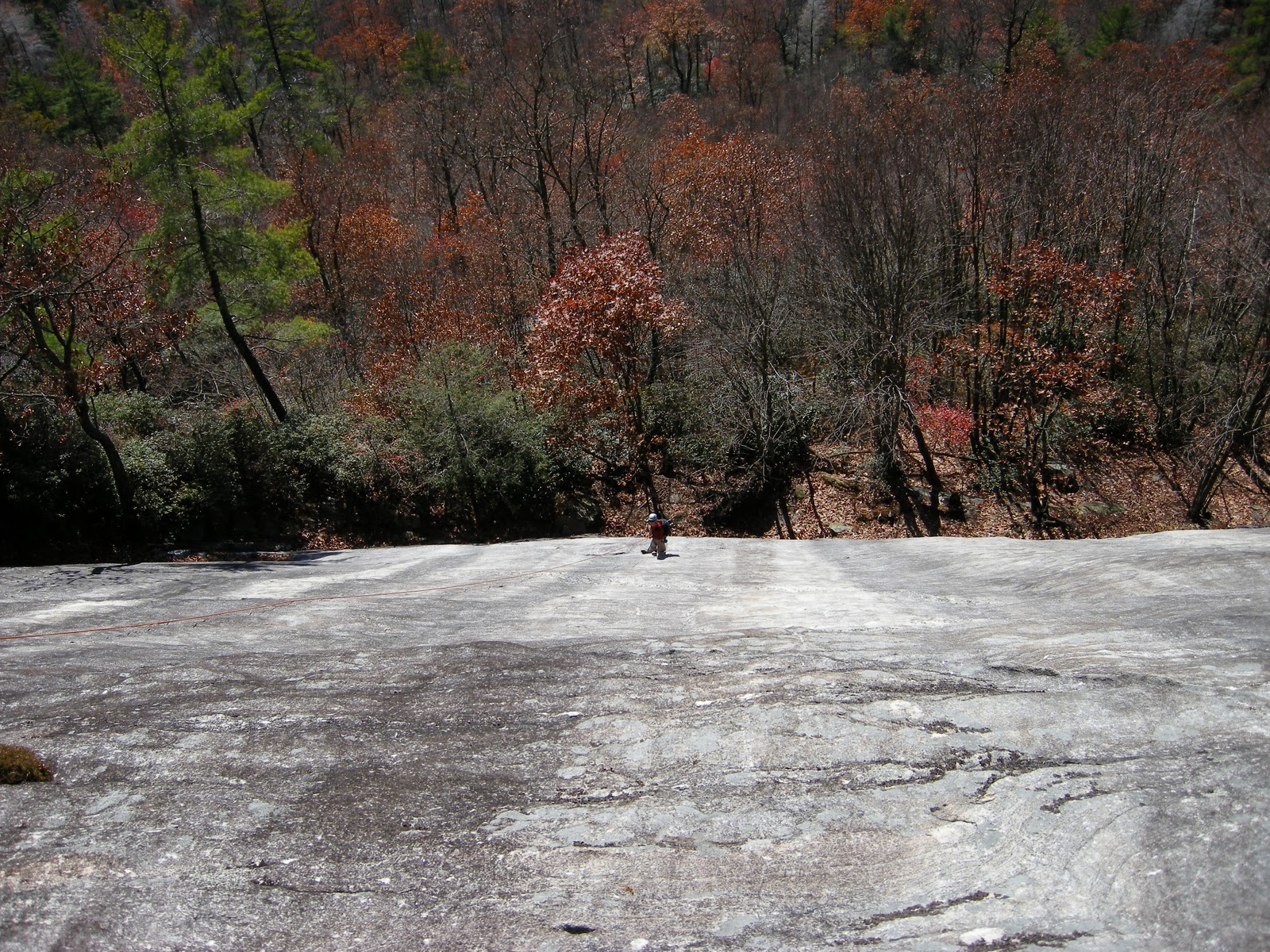
Looking up from the base.  The first pitch climbs the two white streaks to the right.

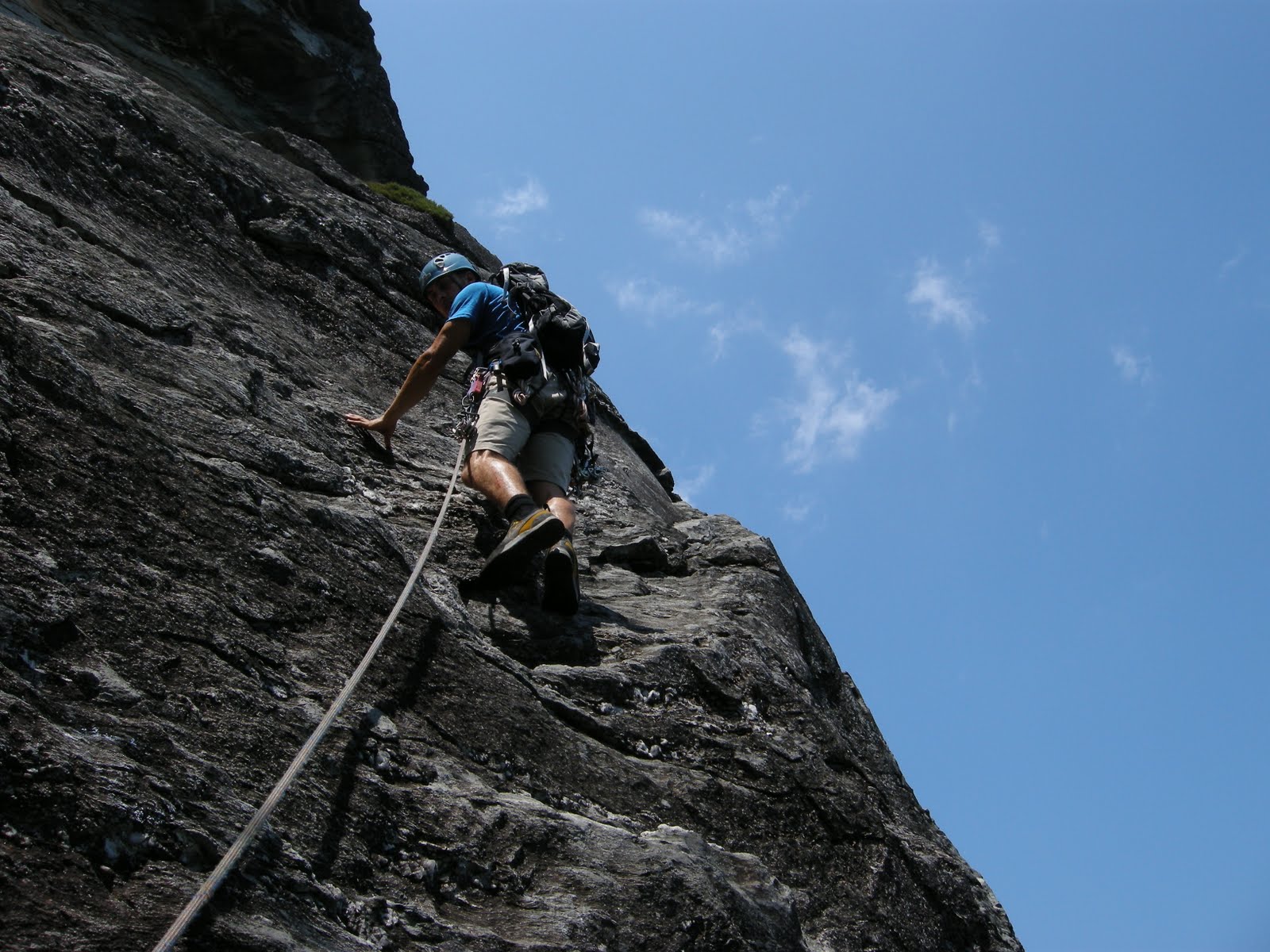
The first pitch was one of the pitches that worried me some.  Even though it is only rated 5.7, it also does not offer any protection.  I knew this.  I started up the route anyways.  I did manage to find one piece of pro about 100 feet up.  After about 140 feet, you hit a ledge.  There I slung a tree and moved left on the ledge, towards the second pitch, to set a belay.  After a few minutes, Michael joined me at the ledge.
Michael climbing the first pitch.

The second pitch proved to be a bit heady as well.  After going to the left side of the ledge, you hit a flake which does not offer much protection.  From there you move through a small roof on large holds and continue up on easy ground to the next ledge.  This is a huge ledge with many trees and vegetation.  From this ledge, you go left once again until the ledge joins with some cracks that head up.  After just a little while in the crack, you traverse right to hit a really fun flake that then joins a big corner.  Then once you are able to, you traverse back left on to a large ledge with a double bolt anchor.  These two pitches go at 5.8 and 5.7.  The hardest part is managing rope drag on the third pitch.

Once on this ledge, you are looking at this section of rock that originally was rated 5.9+.  Now it is given a rating of 5.10c.  The difficulty isn't the big issue though.  The problem is if you fall before clipping the bolt part way up the pitch.  Since you start off on a ledge, you are very likely to hit this ledge.  You get one piece of protection before the bolt.  It is a solid cam.  The only problem is that you are still close to that ledge when you place it.  So once you move above the piece, you are hoping that your belayer is paying close attention.  Once I started up the pitch, I was super nervous.  I probed into the moves a few times but felt uncomfortable.  Finally, I committed to the moves that put me up near the cam that I placed from the ledge.  After this, you have to bear down on a crimp, reach really high for a good hold and hope that your feet stay on long enough to move them onto something better.  Well my first time trying this move resulted in my feet coming off the their holds and me falling towards the ledge.  Michael caught me right as I hit the ledge.  My left foot must have hit the ledge or something on the fall because it had a slight bit of pain.  After a few minutes of regaining my composure I went back up to that piece of gear.  I then attempted to aid through that section but did so without any luck.  The bolt was just a bit too high for me to reach.  I was now forced to free the moves.  This second time I beared down and latched the good hold, moved my feet up and clipped the bolt.  From there I moved up a few moves into easier terrain.  Once up on the ledge, I began the process of trying to settle my nerves so that I wouldn't freak out too much on the upcoming pitches.  Pitch four was done.  It was my biggest worry for the day.

The next pitch was just some 5.7 climbing up to a stance below a small roof.  It must not have been that great since I can't remember much about it.  The sixth pitch though was uber-good.  While looking at it from the belay atop the fifth pitch, I could tell that I was going to have some exposure right off the belay.  Once I was put on belay, I started up this little dihedral that I built my anchor in.  I soon found out that it wasn't the way I was supposed to go.  Instead, you do this airy traverse to the right off of the belay and head up to a dihedral to the right of that little roof.  It was very exposed and unprotected until I hit the roof line.  There I got a piece and moved into the dihedral.  At one point, I got a bit confused as to where the easiest path was.  Eventually, I figured it out, made some super sweet moves and hit a ledge.  From this ledge, you continue up to the belay.  This is the most exposed belay on the entire route.  You have only a few holds to stand on and you are mostly hanging from the anchor.

Michael finishing up the sixth pitch.

The next pitch is the crux pitch if you are trying to free it.  It goes at 5.11a but is well protected by three bolts.  These bolts also allow you to aid through the section making the rating A0.  Once I reached the first bolt, I decided to just aid through this section.  The moves looked very long and by this point I had given up on moves that would be made more difficult for me due to my size.  Above the bolt ladder though, the climbing eases up and you are just climbing on big jugs.  From the top of this next pitch, you can decide to stay with the OR or finish on Traditions.

View from the belay below the Bolt Ladder Pitch

We opted to finish on Traditions.  It offers a more direct line to the top but with some harder climbing.  Also, most people said that it is much more enjoyable than finishing on the last pitches of the OR.  The eighth pitch then, hits a bolted ramp that has some 5.9 moves eventually hitting a large ledge.  The ninth pitch is a steep 5.10a pitch with two bolts.  I was told that this pitch was good but never imagined that it was as much fun as it was.  From the belay, you continue to the left side of the ledge.  There you hit a flake system.  Near the top of the flake, you clip a bolt then make long, overhanging moves on jugs.  After that you continue straight up on some easier jugs until you hit a big tree ledge in which you have to tunnel through vegetation to get on.  While leading this pitch, I couldn't help but yell out of excitement.  I am up a few hundred feet, pulling on jugs in overhanging, exposed terrain with good protection.  I still have a huge smile on my face from that one pitch.  I may also be bold enough to say that it is my single favorite pitch that I have climbed in North Carolina.  This ledge offered a great place to sit and relax for a few minutes.  Michael and I chilled on this ledge for a while, enjoyed a snack while checking out the amazing views offered from our perch.

The last pitch was before us.  Michael had asked if he could lead one pitch on the route, so I gave him the rack and he headed up a 5.8 pitch taking us to the top.  Once we were both up top, we organized the gear, coiled the rope, took a summit picture, and then headed down the trail back to the parking lot.  Once at the parking lot, we enjoyed some burritos we had made.  This was a great way to cap off an amazing day of climbing.  This was one of the best routes I had done in North Carolina.  I can see why it is such a classic route.  It offers fun, bold climbing up an exposed face.  I can't wait to go back and do some more climbing on this face. 
Summit Shot!

Sunday, August 14, 2011

Laurel Knob


 For those of you who follow my life through my blog, you will know that this past spring I moved to North Carolina to start guiding.  You are probably thinking that we are getting tired of hearing this same thing being said in nearly every post.  Well another reason why I came out here was to fulfill some of the requirements for the AMGA’s Rock Instructor Course.  Some of the requirements deal with having to do a certain number of multipitch climbs.  Being from Illinois, it is difficult to get in the number of multipitch climbing for the resume.  It also requires one to have ten grade III climbs.  Grade III climbs are generally described as taking most of a day of roped climbing.  There can be other factors in that as well, such as approach length, bailing options, and of course the length of the climb.  Yesterday, I had the chance to get another grade III route on my resume.  We went to Laurel Knob.

Laurel Knob is said to be one of the tallest faces of rock east of the Rockies.  For years, Laurel Knob was only climbed in secrecy.  It’s not like Laurel is hidden in the backwoods of North Carolina in a place where only the die hearted can see it.  From highway 64 just east of Cashiers, you have a decent view of the face.  It would sit there taunting all climbers because it used to lie on private property.  That didn’t keep people from stealthily going in and climbing.  It amazes me that so many routes were put up in this stealth style.  In the guide book it talks about a prominent first ascentionist putting leather over the striked end of his drill to make the strikes with the hammer quieter.  While I can’t advocate trespassing to climb, it inspires me to read about how these men risked so much to climb this face.  

 Laurel Knob with Fathom in the center

These days, climbing at Laurel Knob is completely legal thanks to the Carolina Climbers Coalition purchasing Laurel Knob in 2006.  They were able to do this thanks to generous climbers and the help of the Access Fund.  Since then, the amazing granite routes at Laurel have been open to all climbers willing to embrace the challenges that the climbing there presents. 

The climbing at Laurel Knob is very interesting.  Like many other areas in Western North Carolina, you need to trust that certain laws of physics will remain constant.  The main one is friction.  The climbing isn’t exactly pure friction climbing for the entire route but unlike other places I have climbed, you have many sections where you are balancing over your feet on a smear that you are hoping will hold long enough to move past it.  There are also many water grooves covering the face.  These grooves offer places to stem and will have holds on them in which you can position your body in certain ways to apply force to either side of the groove so that your feet stay on the rock. 
 
Besides the odd features, the protection can be somewhat limited.  There are bolts throughout the routes and there are places for natural protection.  Even still, you want to bring your A game.  Blowing certain moves could lead to long falls down a slab.  If you think you are up for that kind of challenge, I would recommend going out there and giving the routes a try.  The climbing is fun, challenging, and offers a chance to really get some air under your feet.

Tracy following the third pitch
Now that the introduction is done, I can embark on my day at Laurel.  I went there with another guide here at Fox, Tracy.  Tracy is an amazing climber.  She is always motivated to get out on the rock and be challenged.  Because of this, I was glad to share a rope with her on this day.  We decided on climbing a route called Fathom.  Fathom follows one of the more striking features at Laurel, a right leaning dihedral that goes up the middle of the face.  By leaning, I mean it goes at a 45 degree angle from the left and up to the right.  It then hits a water groove that provides a path through the slightly overhanging wall above and to the left of the dihedral.  

At the base of the route Tracy and I decided which pitches we would lead.  I ended up with the odd pitches and she got the evens.  Once I racked up and had gotten everything I needed, I headed up the first pitch.  It follows the slab to the right of the dihedral up to a grass ledge where you can build a natural belay.  It was a good warm up for what would come later in the route.  Tracy led the second pitch which goes up the slab until it hits the crack again.  From there it follows the crack to a ledge.  I must clarify that even though there is a crack there, you are mostly slab climbing to the right of it.  When you want or can get gear you take a step left and pug a piece in the crack.  We now have two pitches down, a 5.6 and a 5.7 respectively.  
Me following the fourth pitch
I then led the third pitch.  It is given a 5.8 rating.  Though that is well within my comfort zone, there were some tricky moves that I would not have wanted to blow.  I think I was only able to get a few pieces of gear for the entire 130 foot pitch.  When I reached the belay anchor, I started to realize that this was going to be a serious route.  Tracy then led the fourth pitch.  It was a 5.9 pitch that had to go around a bulge.  She did an amazing job on that pitch.  She knows how to keep it together when the gear is limited and you have to climb through some tricky terrain.  After the bulge you come across some white, horizontal dikes that allow you to traverse over to the anchors.  Those were a blast to climb on.  Four pitches down, four more to go.  
Me at the end of the fourth pitch wondering how much more slab climbing I have to do
The beginning of the fifth pitch makes an odd move into a massive flake then follows it back up to the crack.  Once at the crack you have to traverse to the right, passing a bolt before reaching the belay.  This pitch is rated 5.9.  As you may have read, I injured my right foot earlier this year taking a fall on a traverse.   Also, last spring when I was out in central Oregon, I took a fall after a traverse that resulted in me hitting my forearm on a sharp corner while swinging.  Because of these two instances, traverses are something that I do not like.  As you can imagine, this section of the climb was not that comforting to me.  I remember that upon reaching the bolt, I felt a bit of relief but I still had to keep going right.  I managed to find a horizontal that took a .5 camalot.  That made things a bit better.  After a few more tricky moves to the right, I made it to the belay.  It was good to do something that challenged me like that.  Too often I stay in my comfort zone.  Coming out of that zone was a great way to build back that confidence.
Tracy leaving the belay on the fifth pitch
Once Tracy joined me on the ledge she prepared for the crux pitch.  From the belay you go right a few feet and enter into a water groove.  After one bolt, you hit the overhang.  You clip a high bolt, then make some awkward moves to move past the overhang.  The entire pitch has amazing climbing.  Just beware, it can be a little slick in spots.  I ended up falling on the overhang.  As the second, I had to carry the rope which was in a pack that also had too much water in it (my own fault).  The pack kept me from getting my body the way I wanted it on the wall and my feet slid out from under me.  The second time I tried, I just pulled on the draw to get through it.  Then later on in the pitch my foot slipped out from under me and I came off once again.  This pitch was super humbling but amazing at the same time.  Tracy had done all of the route up to this point on another trip but had not done the last two pitches.  Today we would tackle them.
 Tracy getting ready to belay me on the seventh pitch
The seventh pitch takes off right across this very low angled slab to a water groove.  At the base of the water groove you clip a bolt then make some steep moves up the groove.   About fifteen feet later I found sweet stopper placement.  From there on up, there was no more gear.  This put me in a mentally challenging place.  I had to climb very well above that stopper or else I would come down and hit the lower angled slab.  Luckily, I didn’t fall and make it to the belay praising Jesus.  Tracy then took off up the last and final pitch.  It starts in the same water groove as pitch seven but move right to another groove to finish.  The last two pitches were a bit dirty but still fun.  We had a great time climbing the route.  So after 1010 feet we had to rappel back to the ground.  The rappel follows Fathom Direct most of the way down the wall.  It looks like an amazing climb and I cannot wait to come back again to try it.
Tracy coming up the last bit of the seventh pitch
So now, I need only one more grade III to complete the requirements for the Rock Instructor Resume.  I am hoping that I can get back out to Shortoff to do some more routes there.  If anyone would like to join me please let me know.  Hopefully, I can come up with something amazing for my 50th post.  Be looking for it.

Sunday, June 5, 2011

Sport Climbing in North Carolina

As I stated in my last few posts, I am now living in North Carolina.  The climbing here is fantastic.  The climbing here also known for its traditional ethic and lack of bolts on climbs.  Supposedly at Stone Mountain, the bolts are 30 feet apart on some routes. Well, today I went to a place that is unique in this state.  I went sport climbing

Today I got to hang out with two fellow guides, Karsten and Linsay.  They also had a friend of theirs, Sarah, join us.  The four of us set out to this newer crag to get on some steeper bolted routes.  Now around here steep is kind of a relative term.  You see, a lot of the climbing that we have been doing lately has been on the slabs of Looking Glass.  After driving for 1.5 hours, we parked the car and set off down the trail.  From the looks of the trail this place hasn't seen a ton of traffic yet.  Then when we got to the rock, it short.  The routes there were 40-60 feet tall on a metamorphosed sandstone or a quartzite type of rock.  There are good solid edges.  The only thing is lacks is friction.  The routes here were steeper than anything else I had seen in the state so far but that isn't saying much.  There were a few roofs and some climbs overhung a few feet for the entire route.  Basically, it isn't the Red River Gorge in terms of steepness.

After deciding which routes to start on, I went up a route to set up a fixed line so that Karsten could get some photos of us climbing on the route.  I didn't onsight the route but came back later to put it down.  It climbs up small edges with occasional big holds and longer moves.  It was fun.  the other route we got on was a tips crack that you face climbed around.  It wasn't too hard and since you didn't use the crack that much it seemed to lose its appeal. After those two routes we hung out at the first climb getting photos and having a few laughs.

After that I eyed a fist crack around the corner I wanted to try.  I grabbed some gear and went up it.  Unfortunately I didn't have any gear big enough to fit the crack.  Luckily, there was a small crack to the left that took small marginal gear.  As I started up the crack I realized one thing, the inside of this crack is as smooth as a countertop.  I am not joking.  This crack lacked any friction.  Also a few inches into the crack and you were getting into some wet stuff.  Despite these set backs, I managed to find a technique for jamming the crack with my elbow and groveled my way to the top.  It wasn't a bad climb but needs to get climbed more because at the moment it is super dirty.

I then moved over to a sport route that looked like it was an easy 5.11 from the ground.  I started up the route and the moves were comfortable until the third bolt.  Right after clipping it I realized all of a sudden that I was getting into the hard stuff.  After a few attempts, I managed to pull the first hard move, clip the next bolt and scope out the last few moves.  The most powerful move is right after the third bold but after the fourth bolt, you have a dynamic move then there are no more foot holds.  Typically I would start to smear, a move where you paste your foot on the wall and use friction to stand up.  On this rock you can't do that.  There is no friction.  So the last few moves were just attempting to smear and move up to the next good hold.  Finally, I made it to the top and came down to rest for another go.  The second attempt wasn't much better but I made it up it with less falls.

It was nice to check out another crag.  I managed to get some pictures and Karsten seemed to have gotten some good ones.  We had a great time giving our arms a work out instead of our calves.  For those of you interested, you should check out some of Karsten's photography.  He is a very skilled photographer and guide.  He as managed to blend those two passions well.  His site is
www.karstendelap.com.  Here are some of the shots that I got. 


Wednesday, June 1, 2011

Covering Ground at Linville Gorge

Since moving to North Carolina at the end of April, I have been wanting to spend a day doing nothing but moderate multipitch routes.  As a guide wanting to continue to advance in my certifications, I need to climb more multipitch routes for my resume.  Also, I need to learn to move fast in more committing but easier terrain.  This past Tuesday would be the day to do this.  I managed to find a partner.  Kartsen, one of the other guides at Fox Mountain Guides, decided to join me and came up with a plan for the day.  Our plan was to cover as much ground as fast as we could in the Linville Gorge.

A  Panorama from the hike to the Amphitheater

Linville Gorge sits northeast of Asheville.  It is a 14 mile canyon cut by the Linville River.  Normally, it stays cooler there than at Looking Glass since it sit in what is considered the "high country."  Unlike the routes at Looking Glass, the routes at Linville are steeper and have good positive holds.  Climbing in Linville is also much more adventurous. 

Normally, with a plan to cover a lot of ground, groups would start really early in the day or have what is called an alpine start.  We didn't do that.  I met up with Karsten at his house at 7 in the morning.  From there we drove the two plus hours up to Linville.  The road leading up to the parking lot at Table Rock is not fun.  It is a winding gravel road that is full of washouts at nearly every corner.  I guess that is nature's way of keeping you at a reasonable speed.  Once we arrived at the parking lot we noticed one thing, it was already getting hot. Despite the heat, we set off for the Amphitheater area.

Once we arrived at the top of the Amphitheater I had a chance to view some of the climbs we were about to do.  Also, I had the chance to take in the beauty of the area.  Then the realization hit when Karsten told me that we had to get down this gully to get to our climbs.  Gullies are never a fun experience.  Then normally involve steep and loose terrain.  On the way down, I managed to slip a few times and at one point Karsten stepped on a loose rock and it rolled on to his leg almost injuring his ankle and knee.  Thankfully it did nothing more than give us a quick scare.  After about 15 minutes of fighting gravity down the gully we made it to the base of The Daddy.

The Daddy (5.6) is a good route with some amazing pitches in it.  The only bad thing is that the good pitches are short.  This would be a phenominal route if it were more sustained and not so broken up with pitches of just walking up the rock.  To move faster on this route we linked pitches and did fast transitions at belays.  After 470 feet of climbing we were at the top.  One route down.  We quickly checked in with The Spot device so that friends could track our progress.  Then we headed down another gully to the base of The Mummy.

The Mummy (5.5) is an amazing route.  It offers great climbing on every pitch.  Even though it is easier than The Daddy, it was enjoyable to climb 5.5 all the way to the top.  On this climb we did a bit of simul-climbing to move faster.  That is where both the leader and follower are climbing at the same time.  This is only advisable on easier terrain for the experienced climber.  After 380 feet we were back at the top checking in a second time.  We then went down the same descent route as the Daddy then crossed the initial gully to head over to The Prow.

The Mummy (left) and The Daddy (right)

The Prow (5.4) is the preferred way to get out of the Amphitheater.  It is a very easy climb that ascends the buttress across from The Mummy buttress.  Once again we simul-climbed the beginning pitches.  Then Karsten had me lead the last bit.  Even thought it is only 5.4 there is some great exposure on what is normally the 3rd pitch.  Then once you come to a ledge you encounter some obscure moves to reach the final dihedral.  It was a great route and much better than hiking back up that hideous gully.  After that 360 feet we were finished climbing in the Amphitheater.  Our plan now was to head back to the car, refuel, get some more water then head to Table Rock.  At this point we had already climbed 1210 feet according to the guidebook.

The Prow viewed from The Daddy

On the way back to the car I began to realize that I was getting tired.  Not only did we just climb a lot but it was hot.  We had been in the shade most of the morning and I was still drenched with sweat.  Now we were hiking along the ridge line which was not shaded.  After spending a few minutes resting at the car and resupplying we headed up to Table Rock.  Luckily it was a shorter hike. If it had been a longer hike there was a chance that I would have set a rebellion in motion to stop the madness which Karsten had devised.  But that didn't happen and we did some more climbing.

Karsten hiking on our way back to the parking lot

Our first route was Jim Dandy (5.5).  I led the first pitch then we simul-climbed to the top of the climb.  The crazy thing is that it ended on a ledge half way up the wall.  There was another 295 feet.  We then descended down a gully and prepared to head up The Cave Route (5.5).  We simil-climbed the entire route.  Half way up the route I began to realized that my legs were not happy with me.  Since this was all easier terrain, it was lower angle.  This meant that I was using my legs a lot.  At this point they were starting to not function at their normal levels.  I managed to make my way to the same ledge that Jim Dandy ends on.  180 more feet down.  From here we only had two more routes to do.  Luckily, we were already at the base of one of them.

Karsten leading the second pitch of Jim Dandy with his trusty Deuter pack

The ledge where Jim Dandy and The Cave Route end is also the beginning of My Route (5.6).  We headed off to the summit of Table Rock via My Route.  We did it in two pitches.  When I reached the belay, I was so tired that I just plopped down on the ledge and didn't move.  Karsten then started up the next pitch.  While sitting there on the ledge I began noticing that not only was my body not functioning normally but my mind had started to function sub par.  Some how during this state of delirium I regained enough energy to climb the next pitch.  Once on belay, I began climbing as if I wasn't tired at all.  I was really happy to have a few moves that were slightly overhanging.  This allowed me to put more weight on my arms and use poor technique to get through the moves.  Once at the top we put all our gear in our packs then hiked down to the base of our final route, The North Ridge.

Karsten heading up our final climb of the day, The North Ridge

At The North Ridge (5.5), we encountered another group above us.  We had only seen three other people all day.  The three people we saw weren't even climbers.  We met them in the parking lot between crags.  They appeared to have been hiking and as we passed the asked Karsten to take a picture of them with their camera.  I had to laugh that when Karsten was given the camera he started to adjust the settings on the camera.  This amazed the three.  They had someone who knew what to do with a camera taking their picture.  As proof of this you should check out some of Karsten's work www.karstendelap.com.  Anyways, before I digress any further, this other group was about to finish the last pitch as we geared up at the base.  Once ready, Karsten took off up the first pitch.  He brought me up, raced up the last pitch, then brought me up as well.  When I reached the summit the other group was just beginning of coil their rope.  Finally, we were done climbing for the day.  We had just finished climbing 2200 feet of vertical rock.  We packed everything up and practically ran back to the car.  We made it back to the car at 4:30.  Only 7 hours after we initially set off for the Amphitheater.

 
Karsten checking in with the Spot device.

 After reflecting on it, we had a great day of climbing.  Today I have decided to recover from it though.  It was a blast seeing how fast we were able to move.  I have never been pushed so hard on easier terrain like that in my life.  I am currently starting to make a plan to have a similar day up at Looking Glass.  The one difference will be that we do routes that are a bit harder.