Ever since I started climbing, I have always had at least one route that has caught my attention to the point where all I want to do with climbing is to climb that route from the ground up without falling. Last year when I moved to NC I began that process again. Here though, it took quite a while before I found a project or two that I really wanted to work. Last June, I had found the route that I wanted to work on. It was Pawing the Void. For two straight days in June, Ron and I worked on this route. The guide book calls it a 5.12c. It is every bit of 5.12c if not harder.
The crazy part about all of this is that the first day we tried it, I hopped on the route on the sharp end without a warm up. Luckily, you are never pulling super hard but it was quite a difficult route to get on without physically and mentally preparing yourself on an easier route. Since last June, Ron and I have only been on it once since. That was until this past week.
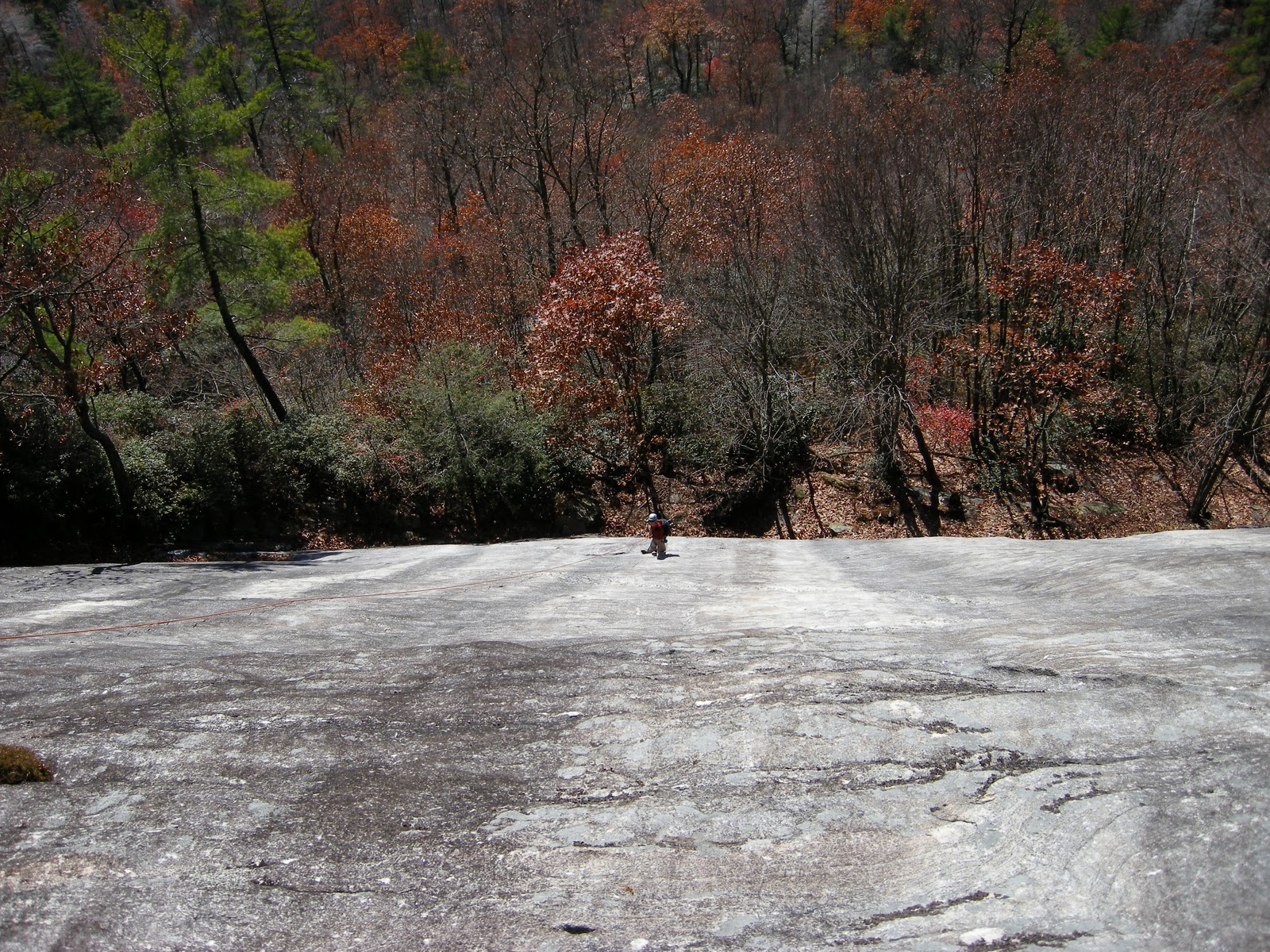
For a while now, I have been bugging Ron to go back out there and work the route with me. Finally, I was able to pull him away from his many other projects so that we could get back on Pawing the Void. This route is turning out to be my main project at the moment. With its thin edges, slopey eye-brows, and barely there holds, it will take quite an effort on my part to get the redpoint. Most of my previous projects have been routes that crescendo in difficulty up to the crux then let off. This route is not like that. The first 20 feet of the route starts at 5.10 then gets up to maybe 5.11. After that you get into the first crux section which is probably 5.12b. After that, the route stays in the 5.12 range and has a long upper crux which causes one to basically levitate on the non-existent holds. Then with a few final moves you are at the chains.
This week, Ron and I plan to get back on it for another session. One thing we learned this past week was that it has to be done in the morning. In the afternoon, it gets hit by sun and is harder to climb then. Also, there is a route about 20 feet to the right that is also on our list of routes. It is a 5.12a with a 5.9 unprotected beginning. I have top roped this routes twice and it is fun. Hopefully in the coming weeks, you will get some reports on our progress with these two great routes.

Monday, April 16, 2012


Tuesday, March 27, 2012
Are You Prepared?
Yesterday, I went climbing with a friend. We were going to try to do five short multipitch routes on the South Side of Looking Glass (First Return, Second Coming, Rat's Ass, Gemini, and Zodiac.) We hike up and start getting ready at the base of the routes. My friend has not done a lot of leading but has shown himself to be proficient at leading on traditional gear so far, so I was going to let him lead the easier pitches on the routes.
Our first route was First Return mostly because everything else was wet in the crux sections of the climbs. I led up to Sentry Box Ledge then brought up my friend. Since the first pitch of First Return is the crux, I led it. I set up the belay and bring him up. At the belay we exchange gear and I tell him a bit about the pitch ahead. I can see that it is slightly wet but I didn't think it would be too bad.
He headed up the pitch. He was doing well. He had gotten what I would consider adequate gear and was just getting into the wet stuff. As he slowly moved up the wet holds, I could tell when he had found another place to get some gear. A second after I see him relax a bit, I see him slip and come falling down. I was only able to take up a little bit of rope. Once he stopped falling I could tell that he was injured. His posture and he was obviously in pain from his exclamations. Since he was alert and it was only one ankle that was bothering him, I lowered him down to the belay. There we did a quick check on the ankle. Everything was still in the skin and it wasn't hurting him horribly. He offered to let me finish the lead to get all my gear back. I made sure he was cool with that, then headed up.
Upon getting to the base of the wet section I could see what happened on his fall. The first part of the pitch is slabby terrain and where the water was, it becomes a bit more vertical. The piece he fell on was a bomber .5 Camalot in an eyebrow. The only problem was that it was at the beginning of the vertical section. This means that if you fall on the vertical section you hit the slab below fairly hard. This is what caused his injury. I then started climbing into the wetness. After a few moves, I was above my piece already and unsure of the footing on the wet rock. I didn't want to risk both of us getting injured so I elected to down climb the pitch and try to get most of the gear back off of that pitch. I did have to lead one piece.
Once back at the belay, I told my friend that I was going to lower him to Sentry Box ledge and I would rappel down. I did this to minimize gear left on the route. Once back at the ledge with my friend, we did a tandem rappel to the ground so that he would be able to balance against me while going down. Once on the ground we checked out his ankle closer. He had swelling and tenderness in a few spots. We figured that he had sprained it pretty bad during the fall. Now we had a 3/4 of a mile hike back to the car with some of the terrain kind of blocky and steep. I acted as a crutch on his side of the injury and he also had a walking stick we found. This allowed him to keep all of his weight off of the bad ankle. We made it back to the car in 1.5 hours. Normally, this hike only takes 30 minutes.
This was the first real injury that has happened to me and a climbing partner while on a multipitch route. In single pitch terrain, the general rescue skill you need to know is just to lower your partner back to the ground. In multipitch settings, it can become much more difficult. Luckily, I have worked on self rescue skills. They are tools that I hope to never have to use but as I found out, even just something like a sprained ankle can make getting off of a route more difficult. Also, having some form of medical training. A requirement for my job is to have my Wilderness First Responder certification. In the areas where we work and play, it can take quite a while to get someone to help. If I hadn't had that training, I might have freaked out with my friends injury and called for help to carry him out on a litter. If I would have done that, we probably would have been out there many more hours. Since his injury was not life threatening, we simply just had to take our time to get out.
For those of you who read this and partake in adventurous activities in the outdoors, I would recommend you take a wilderness medicine course and for the climbers, take a self rescue course. We offer such a course here at Fox Mountain Guides. Unfortunately, many climbers don't see how important a course like this can be until it is too late.
Our first route was First Return mostly because everything else was wet in the crux sections of the climbs. I led up to Sentry Box Ledge then brought up my friend. Since the first pitch of First Return is the crux, I led it. I set up the belay and bring him up. At the belay we exchange gear and I tell him a bit about the pitch ahead. I can see that it is slightly wet but I didn't think it would be too bad.
He headed up the pitch. He was doing well. He had gotten what I would consider adequate gear and was just getting into the wet stuff. As he slowly moved up the wet holds, I could tell when he had found another place to get some gear. A second after I see him relax a bit, I see him slip and come falling down. I was only able to take up a little bit of rope. Once he stopped falling I could tell that he was injured. His posture and he was obviously in pain from his exclamations. Since he was alert and it was only one ankle that was bothering him, I lowered him down to the belay. There we did a quick check on the ankle. Everything was still in the skin and it wasn't hurting him horribly. He offered to let me finish the lead to get all my gear back. I made sure he was cool with that, then headed up.
Upon getting to the base of the wet section I could see what happened on his fall. The first part of the pitch is slabby terrain and where the water was, it becomes a bit more vertical. The piece he fell on was a bomber .5 Camalot in an eyebrow. The only problem was that it was at the beginning of the vertical section. This means that if you fall on the vertical section you hit the slab below fairly hard. This is what caused his injury. I then started climbing into the wetness. After a few moves, I was above my piece already and unsure of the footing on the wet rock. I didn't want to risk both of us getting injured so I elected to down climb the pitch and try to get most of the gear back off of that pitch. I did have to lead one piece.
Once back at the belay, I told my friend that I was going to lower him to Sentry Box ledge and I would rappel down. I did this to minimize gear left on the route. Once back at the ledge with my friend, we did a tandem rappel to the ground so that he would be able to balance against me while going down. Once on the ground we checked out his ankle closer. He had swelling and tenderness in a few spots. We figured that he had sprained it pretty bad during the fall. Now we had a 3/4 of a mile hike back to the car with some of the terrain kind of blocky and steep. I acted as a crutch on his side of the injury and he also had a walking stick we found. This allowed him to keep all of his weight off of the bad ankle. We made it back to the car in 1.5 hours. Normally, this hike only takes 30 minutes.
This was the first real injury that has happened to me and a climbing partner while on a multipitch route. In single pitch terrain, the general rescue skill you need to know is just to lower your partner back to the ground. In multipitch settings, it can become much more difficult. Luckily, I have worked on self rescue skills. They are tools that I hope to never have to use but as I found out, even just something like a sprained ankle can make getting off of a route more difficult. Also, having some form of medical training. A requirement for my job is to have my Wilderness First Responder certification. In the areas where we work and play, it can take quite a while to get someone to help. If I hadn't had that training, I might have freaked out with my friends injury and called for help to carry him out on a litter. If I would have done that, we probably would have been out there many more hours. Since his injury was not life threatening, we simply just had to take our time to get out.
For those of you who read this and partake in adventurous activities in the outdoors, I would recommend you take a wilderness medicine course and for the climbers, take a self rescue course. We offer such a course here at Fox Mountain Guides. Unfortunately, many climbers don't see how important a course like this can be until it is too late.
Thursday, February 23, 2012
North Conway Ice
This year has been a less than desired winter for those people who enjoy outdoor winter activities. Snowfall has been very minimal and average temperatures have been above average. For some people, this is the best thing that can happen in winter. For those of us who enjoy skiing, snowboarding, snowshoeing or ice climbing it leaves us reminiscing of great winters past. Here in North Carolina, the winter has been rather disappointing. With the number of days with climbable ice able to be counted without taking off your shoes and socks many of us were craving colder weather in which we could climb those ever evasive icicles. Luckily, I would not be denied my chance to scratch my way up some vertical, frozen water.
In past February's, Fox Mountain Guides hosts a trip to North Conway, New Hampshire to instruct ice climbing and basic mountaineering. This year was no different and I was given the chance to go and take care of our guests. We rent a chalet and house the guides and the guests. I was supposed to make sure that everyone is well fed and is comfortable while there. That task proved to be a challenge to me since I am not the more organized person. The upside was that I got to climb ice. I managed to do my fair share of that.
The first couple of days, I was privileged to shadow the Ice 101 course taught by Karsten and Lindsay. I helped out a bit and was able to pick up some tips that would later improve my ice climbing ability. We spend a day at Cathedral Ledge, Frankenstein, and Trollville. With three days under my belt and Lindsay having a few days off, we decided to go have our own fun on the ice. The first day of the 201 course, Lindsay and I headed to Frankenstein to get a few laps in and to shoot some photos and video of the 201 course. While we were there we ran a few laps on different sections of Dracula. From there we hiked along the top and came in above the 201 crew on the Standard Route. I belayed Lindsay as she went up and down capturing footage of the guys.
The next day, Lindsay and I headed back to Frankenstein. There we went up Chia which is this two pitch WI3. Very fun route. The only problem was that it was a little warm so by the time we got to the top, the ice began to soften a bit. From there we went over and top-roped Pegasus. It was even better than Chia but we had to be careful with the top out since the ice had started to delaminate from the rock. We climbed quite a bit of moderate ice that day. After this day, I was feeling more confident on the ice.
The day after climbing at Frankenstein, Lindsay had a client so I was on my own. I managed to get some work done at the chalet before heading out and joining the 201 course. I arrived just in time to go up a two pitch line called Thresher Slabs with Karsten and two of the guys in the course. It was fun but didn't feel like it was enough for the day. After walking back to the base, I decided to solo up a WI2 slab. It was easy but I was able to find a few short vertical sections on it to up the difficulty. Though I didn't get much in this day, Ron would be free to climb for the next few days. Then we would be getting on some of the classic, hard routes in the area.
The first day that Ron and I climbed, we headed to Cathedral Ledge to climb a route called Remission. It is a WI5+ with a M5 first pitch. On this wall, there is also another classic line called Repentance. Ron said that he had never done Remission so I willingly agreed to follow him up this classic line. The first pitch is a corner system that you either dry-tool or climb like you would any other rock climb. This leads to a thin section of ice before reaching the belay ledge. When following this pitch, I attempted to dry-tool part of it and fell off when my tool slipped off the edge it was on. After this I managed to make my way up to the belay without any problems. The second pitch goes left off the belay. There you clip a pin and pull your way up on to a hanging curtain. This is the best part of the climb. It is exposed but super solid. After a few minutes Ron was at the belay and it was my turn to play on the ice. After unclipping from the piton, I looked at the curtain. It was going to be tricky for me to reach it due to my lack of height. After some awkward moves I was established on the curtain and making my way up the ice to Ron. The third pitch, which is said to be the crux, goes up this steep column into a chimney with ice in the back. Ron quickly dispatched the column but while climbing the chimney, I would occasionally hear grunting. This worried me just a bit. Once Ron made it to the belay I began my journey up. The column was fun and exposed. Once in the chimney I was able to see why Ron was grunting. With many awkward moves to good stances, the chimney takes quite a while to climb. At the top you have to come out and around a chockstone which creates a few more tricky moves. At the top of the third pitch you can either rappel or continue up and walk off. We were going to walk off so we continued up one more pitch. It goes deeper into the chimney then has some crazy moves that put you on a snow/ice covered low angled terrain. Getting out of the chimney proved to provide a few more hard moves for the route. After making it to the top, we followed the cliff line to the north towards the walk down. Once back at the base of the cliff, I led a WI3 which is one of the North End Pillars. It was fun.
The next day, Ron had a route in mind that he had tried to find the year before called Drool of the Beast. It is a WI5 located near Greeley Lake. After a mile and a half hike in, we were finally able to see it. Now we just had to figure out how to get there. We continued hiking up the main trail until we spotted a slightly used path of potholes in the snow. I figured this was the trail. It did include a bit of a bushwack though. Once we arrived at the base, we noticed one thing; this climb was in the sun and it was not that cold. The first section of the climb looked rather thin but once you were up about 25 feet, the ice was thicker. Ron started up. Luckily, he found good rock gear since the ice at the beginning was not taking any screws. The only issue was that the ice was falling apart. After doing an amazing job with leading this challenging pitch, Ron put me on belay. I got to the thin ice in a wide chimney. The ice was no longer solid. It had turned to slush. I was moving from rock to slush and back to rock to get to the good ice. Once at the good ice, I took out one of the few good screw placements on the route trying to not get soaked by the melting of the route above. I continued to climb up the less than idea ice. The last 30 feet of the route is a steep section that is about 3-4 feet wide. It was also a bit slushy but was deep enough that I was able to bury the ice tool in it so that it would be solid. Finally, after a daunting sprint up the final bit I made it up to the top. After this, we got out of there knowing that it would not be safe to climb anything else that day due to the warm conditions.
The final day that I would climb one of the classic lines, Ron and I did Repentance. It is a WI5 to the left of Remission. It is mostly ice climbing with a finish that will challenge you. Ron offered to let me lead the first pitch which goes at WI4. Since I felt this was still a bit above my head for leading, I declined and allowed Ron to lead it. Ron also led the second pitch which had this hanging curtain which we had to figure out how to get our feet onto it since there was a 3.5 foot gap between the curtain and where the stance was below it. When I arrived at the top of the second pitch, Ron asked if I would lead up to a ledge about 20 feet higher. He said that his belay was uncomfortable and with the crux pitch looming above us I would be better off at the nicer ledge. After thinking about it for a minute I grabbed some gear from Ron and headed up. The ice was interesting. I managed to stem between it and the rock on the left. Finally, after a little bit I traversed left towards the ledge. The only odd part was that there was no ice to swing at. I eventually stuck my axes in the ice on the belay ledge, then rock climbed the rest of it. Ron then led the last pitch. It went smoothly. It was my turn. I had seen this pitch before on a few videos. I knew what the top of this pitch held for me. Yet, when I arrived at the rock roof I was unsure how to get into it. Eventually I fell off. After some scraping with the tools, I was able to struggle my way to the top.
After spending a few days with Ron climbing these classic, hard lines; we were joined by another friend. We got two more days in together. I ended up leading another WI3. In my 13 days up in New Hampshire, I was able to get out and climb 11 of them. This trip was a great chance for me to improve on my technique on ice. I was able to learn a lot from people like Ron, Karsten and Lindsay. Being back here in North Carolina with the weather looking as if it will not bring us any more ice, we have been getting back into rock mode. Since I have been back, I have abused my body on the rock getting back in shape. Hopefully soon, you will read of some great days on the rock.
In past February's, Fox Mountain Guides hosts a trip to North Conway, New Hampshire to instruct ice climbing and basic mountaineering. This year was no different and I was given the chance to go and take care of our guests. We rent a chalet and house the guides and the guests. I was supposed to make sure that everyone is well fed and is comfortable while there. That task proved to be a challenge to me since I am not the more organized person. The upside was that I got to climb ice. I managed to do my fair share of that.
The first couple of days, I was privileged to shadow the Ice 101 course taught by Karsten and Lindsay. I helped out a bit and was able to pick up some tips that would later improve my ice climbing ability. We spend a day at Cathedral Ledge, Frankenstein, and Trollville. With three days under my belt and Lindsay having a few days off, we decided to go have our own fun on the ice. The first day of the 201 course, Lindsay and I headed to Frankenstein to get a few laps in and to shoot some photos and video of the 201 course. While we were there we ran a few laps on different sections of Dracula. From there we hiked along the top and came in above the 201 crew on the Standard Route. I belayed Lindsay as she went up and down capturing footage of the guys.
The next day, Lindsay and I headed back to Frankenstein. There we went up Chia which is this two pitch WI3. Very fun route. The only problem was that it was a little warm so by the time we got to the top, the ice began to soften a bit. From there we went over and top-roped Pegasus. It was even better than Chia but we had to be careful with the top out since the ice had started to delaminate from the rock. We climbed quite a bit of moderate ice that day. After this day, I was feeling more confident on the ice.
The day after climbing at Frankenstein, Lindsay had a client so I was on my own. I managed to get some work done at the chalet before heading out and joining the 201 course. I arrived just in time to go up a two pitch line called Thresher Slabs with Karsten and two of the guys in the course. It was fun but didn't feel like it was enough for the day. After walking back to the base, I decided to solo up a WI2 slab. It was easy but I was able to find a few short vertical sections on it to up the difficulty. Though I didn't get much in this day, Ron would be free to climb for the next few days. Then we would be getting on some of the classic, hard routes in the area.
The first day that Ron and I climbed, we headed to Cathedral Ledge to climb a route called Remission. It is a WI5+ with a M5 first pitch. On this wall, there is also another classic line called Repentance. Ron said that he had never done Remission so I willingly agreed to follow him up this classic line. The first pitch is a corner system that you either dry-tool or climb like you would any other rock climb. This leads to a thin section of ice before reaching the belay ledge. When following this pitch, I attempted to dry-tool part of it and fell off when my tool slipped off the edge it was on. After this I managed to make my way up to the belay without any problems. The second pitch goes left off the belay. There you clip a pin and pull your way up on to a hanging curtain. This is the best part of the climb. It is exposed but super solid. After a few minutes Ron was at the belay and it was my turn to play on the ice. After unclipping from the piton, I looked at the curtain. It was going to be tricky for me to reach it due to my lack of height. After some awkward moves I was established on the curtain and making my way up the ice to Ron. The third pitch, which is said to be the crux, goes up this steep column into a chimney with ice in the back. Ron quickly dispatched the column but while climbing the chimney, I would occasionally hear grunting. This worried me just a bit. Once Ron made it to the belay I began my journey up. The column was fun and exposed. Once in the chimney I was able to see why Ron was grunting. With many awkward moves to good stances, the chimney takes quite a while to climb. At the top you have to come out and around a chockstone which creates a few more tricky moves. At the top of the third pitch you can either rappel or continue up and walk off. We were going to walk off so we continued up one more pitch. It goes deeper into the chimney then has some crazy moves that put you on a snow/ice covered low angled terrain. Getting out of the chimney proved to provide a few more hard moves for the route. After making it to the top, we followed the cliff line to the north towards the walk down. Once back at the base of the cliff, I led a WI3 which is one of the North End Pillars. It was fun.
The next day, Ron had a route in mind that he had tried to find the year before called Drool of the Beast. It is a WI5 located near Greeley Lake. After a mile and a half hike in, we were finally able to see it. Now we just had to figure out how to get there. We continued hiking up the main trail until we spotted a slightly used path of potholes in the snow. I figured this was the trail. It did include a bit of a bushwack though. Once we arrived at the base, we noticed one thing; this climb was in the sun and it was not that cold. The first section of the climb looked rather thin but once you were up about 25 feet, the ice was thicker. Ron started up. Luckily, he found good rock gear since the ice at the beginning was not taking any screws. The only issue was that the ice was falling apart. After doing an amazing job with leading this challenging pitch, Ron put me on belay. I got to the thin ice in a wide chimney. The ice was no longer solid. It had turned to slush. I was moving from rock to slush and back to rock to get to the good ice. Once at the good ice, I took out one of the few good screw placements on the route trying to not get soaked by the melting of the route above. I continued to climb up the less than idea ice. The last 30 feet of the route is a steep section that is about 3-4 feet wide. It was also a bit slushy but was deep enough that I was able to bury the ice tool in it so that it would be solid. Finally, after a daunting sprint up the final bit I made it up to the top. After this, we got out of there knowing that it would not be safe to climb anything else that day due to the warm conditions.
The final day that I would climb one of the classic lines, Ron and I did Repentance. It is a WI5 to the left of Remission. It is mostly ice climbing with a finish that will challenge you. Ron offered to let me lead the first pitch which goes at WI4. Since I felt this was still a bit above my head for leading, I declined and allowed Ron to lead it. Ron also led the second pitch which had this hanging curtain which we had to figure out how to get our feet onto it since there was a 3.5 foot gap between the curtain and where the stance was below it. When I arrived at the top of the second pitch, Ron asked if I would lead up to a ledge about 20 feet higher. He said that his belay was uncomfortable and with the crux pitch looming above us I would be better off at the nicer ledge. After thinking about it for a minute I grabbed some gear from Ron and headed up. The ice was interesting. I managed to stem between it and the rock on the left. Finally, after a little bit I traversed left towards the ledge. The only odd part was that there was no ice to swing at. I eventually stuck my axes in the ice on the belay ledge, then rock climbed the rest of it. Ron then led the last pitch. It went smoothly. It was my turn. I had seen this pitch before on a few videos. I knew what the top of this pitch held for me. Yet, when I arrived at the rock roof I was unsure how to get into it. Eventually I fell off. After some scraping with the tools, I was able to struggle my way to the top.
After spending a few days with Ron climbing these classic, hard lines; we were joined by another friend. We got two more days in together. I ended up leading another WI3. In my 13 days up in New Hampshire, I was able to get out and climb 11 of them. This trip was a great chance for me to improve on my technique on ice. I was able to learn a lot from people like Ron, Karsten and Lindsay. Being back here in North Carolina with the weather looking as if it will not bring us any more ice, we have been getting back into rock mode. Since I have been back, I have abused my body on the rock getting back in shape. Hopefully soon, you will read of some great days on the rock.
Sunday, January 22, 2012
Review: Bonhoeffer; Pastor, Martyr, Prophet, Spy

A few years ago, I read one of his prized works, The Cost of Discipleship. It was a great book and had a great breakdown of the Sermon on the Mount found in the gospel of Matthew. In it there was a brief history of Bonhoeffer. I was captivated by the few pages written about this man who had written the book I was about to read. Somehow in my studies in college, I never heard much about this man. Since then, I had desired to learn more of this man that became a martyr during the rule of the Third Reich.
While I was at a friend's house around Christmas, I noticed this thick, blue book with the word Bonhoeffer written in white letters on the spine. I pulled the book off of the shelf to take a look. This interested me. Here is this massive biography of a man that I want to learn more about. After forcing myself to not open the book and start reading at that moment, I placed it back on the shelf and logged it into my memory as something I must read one day. A few days later I find myself at the bookstore hoping to find The Crucified God by Moltmann. They didn't have it. I should not have expected a normal books store to have in stock a book that even most Christians know nothing about. What did catch my eye that night was the thick, blue book with Bonhoeffer written in white on the spine. I quickly picked up that book and proceeded to the check out.
This book quickly sucked me in to the story and life of Dietrich. Though it starts off with a bit of a history not of Dietrich himself, but of his family and lineage. We learn that his grandfather was a great theologian, that his father was an honored psychiatrist of the day and of many other family members that were influential during their own lives in Germany. From the start this man is from good, German stock. Something that one of his opponents would have been proud. We also get a great glimpse into the early life of Dietrich and the rest of his immediate family. One thing that is very clear from the start, this family was very close, they were well educated but also knew how to enjoy the wonderful things in life.
While Dietrich was still young, World War I broke out. Metaxas, the author, gives a great view into the historical and sociological context during this period of Germany. With the defeat of Germany in the war and the restrictions placed upon them from the treaties, Germans felt humiliated. This led to many changes in government and how daily life happened after the war.
The author also notes the brilliance of Bonhoeffer during his academic career. During this time, classical liberalism, particularly in the field of theology was the popular view. He was one of the few that opposed those views but did so with great dignity and respect from his teachers and colleagues. After achieving his doctorate in his early 20's Bonhoeffer began traveling to work with congregations in different parts of the world. His travels took him to Rome, Spain, America, and London. These travels influenced his love of the art and his enthusiasm for the ecumenical movement. It was fascinating to see how all of this information shaped this young man.
As most you will know, the National Socialists (Nazis) came into power under the leadership of Adolf Hitler. As time went on, this government would slowly change the government, society, and church in Germany. Bonhoeffer was one of those that opposed the changes made particularly within the church. Along with other pastors and leaders, they began the Confessing Church. Dietrich also used his ecumenical ties with pastors and leaders in England, Switzerland, and American to let the world know of the horrors that were happening in Germany during this time.
Through all of this, the Nazis became more powerful and started to use their forceful tactics to get people to fall in line. Eventually, Bonhoeffer traveled back to the U.S. to teach and lecture. This was short lived because he knew his place was in Germany with his suffering brothers. Through a friend, he was able to become a government agent for Germany. He used this position to eventually rebel against the Third Reich. Many of those people that Bonhoeffer was close to were a part of the resistance even though they were high ranking military and government officials. They also planned many assassination attempts on Hitler, with them all failing. After the failed attempt on July 20, 1944, which the movie Valkyrie is based, many in the resistance were arrested, Bonhoeffer included. Eventually, he was killed only days before the camp he was being held in was liberated by the Allies.
Though he is known for his resistance to the Nazis, that is not what stood out to me the most. It seemed that everywhere he went, he enjoyed life and took every opportunity to learn new things, broaden his knowledge and impact the people he was in charge of. While he was a professor in Berlin, he would often invite his students to "hang out" as it were. He became involved in their lives. He did this same thing with a class of confirmants he was assigned to. This also led to similar practices when he started two illegal seminaries in Germany. I also enjoyed what seemed to be a great balance of academia along with living his life as close to what Jesus did.
Though I feel that I told you a great deal about his life, the details found in the book bring this man to life in the words of the pages. After a few chapters, I felt connected to this man who lived over 70 years ago. I hope that you will be able to read this book in the near future. I would say that it was one of the best books I have read in my life. I have said that about many previous readings but none have been so inspiring as this. If you have read it, tell me what you though about it.
Saturday, January 7, 2012
Ice Climbing
The year was 2007. I was less than a year out of college and I still
had no idea what direction my life was taking. At the end of the year,
I took a trip out to Colorado with two climbing partners, David and
Scott. Our goal was to climb some ice. This trip was slightly
intimidating to me. I had never climbed ice before. Also, I had never
been to Colorado before this trip. Little did I know that it would be
the first of many trips to this great state. On the drive out I soaked
in as much information on how to ice climb. I knew that you would swing
these weapon like tools into the ice, then kick your crampons into the
ice and move up that way. Basically, that is what you do but there are
other more finite nuances that can help improve your skills on this
frozen medium.
After a few days of seeing ice and not climbing it due to either snow or weather conditions we continued on to Ouray, CO. There in this small mountain town in southwestern Colorado, there is a premier ice park. Basically, they take this box canyon on the edge of town and make ice flows every 15-20 feet along an entire side of the canyon. There is so much ice and it tends to get fat quick. This would be my chance to learn in a convenient location. It isn't often that you can walk 5 minutes from your hotel and be gearing up at the top of your climb. During this trip, I top-roped many pitches of ice up to WI5*. Buy the end of the trip I was hooked and couldn't wait until the next chance I would have to get back on ice.
Though ice forms in certain places in the midwest, I had one thing keeping me from seeking it out. I had no ice climbing gear except the used mountaineering boots that I purchased while in Colorado. Finally, in the winter of 2010/2011 I had the necessary gear to go out and top-rope ice. I had boots, crampons, and axes. I was set. Luckily, some ice formed up in southern Illinois. I spent one day playing on the frozen waterfalls. Soon after that, the temperatures began to rise which quickly melted the waterfalls we had climbed. This led us back to climbing on rock. This one day of climbing did rekindle my desire to get on ice.
A few months after that day of climbing ice I moved to North Carolina. It was then that I heard about the ice climbing opportunities here in the south. Already in April I was wanting winter to arrive and the ice to form up. Back in November was the first time I saw any ice here. One morning Karsten asked me if i wanted to go check on the conditions of the ice on Highway 215 near the Blue Ridge Parkway. I readily hopped in the car and we took off. It was thin and barely there but just the sight of ice got me psyched.
This was going to be the year that I progress in my ice climbing. Since ice climbing can be a much more dangerous activity than rock climbing, more care is taken to avoid injuries. In ice climbing you are told that when leading you do not fall. This is mostly because while climbing ice you have around two dozen spikes attached to you. In a leader fall those spikes could catch on the ice, resulting in a sprained or broken leg or one of those spikes could find itself piercing through a piece of your clothing and into your skin. Neither of these options sound like something I desire to do. Because of this, I had never led any ice. Also, I do not own the proper equipment to lead ice. In ice climbing you place ice screws into the good parts of the ice. As long as the ice is of decent quality, those screws will hold a fall if you happen to slip, which you should try to avoid. Little did I know that this would all change shortly.
Finally, the ice formed up enough to climb it. At that same time, my friend Caroliegh came up from Georgia to climb. I asked her if she wanted to go ice climbing. A little reluctant at first since she doesn't enjoy the cold, she soon agreed. The morning we were going to go ice climbing, Ron, one of the other guides here at Fox, texted me and asked if we were still going climbing and wanted to join. This was nice since Ron has more experience on ice than I do. We met up with Ron and started the drive up 215. Little did I know that we were not going to climb at the main walls on 215. When Ron instructed me to continue past them while driving I knew he had something better planned. This sometimes scares me. Ron has been on of those guys who is always up for an adventure and also pushes me more than most people. He then told us that we were going to do a climb called Creek Stomp.
We continue driving north on 215 past the parkway and back down hill in Haywood county. After a few miles, Ron tells me to pull off along side the road. We gear up then begin a hike into the woods. Ron had told me about a previous trip here he took with Lindsay, another guides, where they went up the wrong gully and were forced to do some nasty bushwacking to crest a ridge to the proper gully. After hiking for about ten minutes up the gully Ron voiced concern that he may have led us into the wrong gully. He then scouted ahead while Caroliegh and I waiting. Luckily, he soon found the beginning of the ice and we headed up to meet him. Once we caught up, we started to put our harnesses and crampons on. I was then informed that I would have the chance to practice my short-roping skills on ice. I was not expecting this but hey, I could use the practice. While I prepared my coils for short-roping, Ron began instructing Caroliegh on how to use the crampons. We made our way up the low angled frozen creek until we caught up with Ron at a sheet of vertical ice. I was stoked. Finally, we would get to swing our tools. When I arrived, Ron pointed out that there were already ice screws with quickdraws in the ice. He had soloed up and placed the screws on this pitch for me to lead up. Time to pinkpoint this pitch
I headed up. It was a very chill pitch. I would guess it goes at WI2. After a few screws, the angle lessens. I continued up with no protection, I didn't get any more screws from Ron, to a tree that is used as a rappel station. There I belayed Caroliegh up while Ron climbed along side her to help her out. While we were at the rappel station, you could hear Bella below whining. Bella had ascended the slope next to the creek which was just a snow covered hill. Now with a wall of ice impeding her ascent she became unhappy. Until suddenly, a very happy looking dog appeared in the brush next to us. It was Bella. She found an alternate route to the side of the vertical ice. We continued up the creek from there to another wall of ice. This one was taller and steeper than the first. When I arrive Ron has this goofy looking grin on his face which means that I get to lead this one as well.
This pitch, according to Ron, is a WI3. It has four vertical sections broken up by good stances. I started climbing. At the first stance, I placed my first screw. Then I continued up the next vertical section. During this part I began to get wet from the climb dripping on me. I reach the second stance and place another screw. Things are looking good. From here I head up to the third stance and place my third screw. Here I chill out for a little bit and scope out the best way to the top of the climb. The next section, I traverse to the left to surmount the next vertical section to the last stance. At the last stance, I am only a few moves from the top of the pitch. I considered placing a screw here but chose not to mostly because I just wanted to get to the top quickly. I start up the last section. I am able to reach past some ice that isn't that great but I must use it for my feet. Right before pulling the lip to the top, My left foot comes off the ice. Luckily, my axes are in good so I grip down and pull myself up just a bit to get my feet back on good ice. One or two moves later and I am standing up top of my first true ice lead. From there I brought Caroliegh up. Ron made his way up by some other means. At the top of this pitch we decided to head back to the car then get a lap or two in at 215. We rappelled down and made our way back to the car.
This day got me very excited for the trip that Fox Mountain Guides is taking to New Hampshire in February. I just hope I will have time to get out and climb a lot. It is going to be a great trip. If you would like to learn about how you can join us feel free to contact me.
*WI is the prefix for a Water Ice rating. http://en.wikipedia.org/wiki/Ice_climbing this link will give you a good description of ratings.
After a few days of seeing ice and not climbing it due to either snow or weather conditions we continued on to Ouray, CO. There in this small mountain town in southwestern Colorado, there is a premier ice park. Basically, they take this box canyon on the edge of town and make ice flows every 15-20 feet along an entire side of the canyon. There is so much ice and it tends to get fat quick. This would be my chance to learn in a convenient location. It isn't often that you can walk 5 minutes from your hotel and be gearing up at the top of your climb. During this trip, I top-roped many pitches of ice up to WI5*. Buy the end of the trip I was hooked and couldn't wait until the next chance I would have to get back on ice.
Though ice forms in certain places in the midwest, I had one thing keeping me from seeking it out. I had no ice climbing gear except the used mountaineering boots that I purchased while in Colorado. Finally, in the winter of 2010/2011 I had the necessary gear to go out and top-rope ice. I had boots, crampons, and axes. I was set. Luckily, some ice formed up in southern Illinois. I spent one day playing on the frozen waterfalls. Soon after that, the temperatures began to rise which quickly melted the waterfalls we had climbed. This led us back to climbing on rock. This one day of climbing did rekindle my desire to get on ice.
A few months after that day of climbing ice I moved to North Carolina. It was then that I heard about the ice climbing opportunities here in the south. Already in April I was wanting winter to arrive and the ice to form up. Back in November was the first time I saw any ice here. One morning Karsten asked me if i wanted to go check on the conditions of the ice on Highway 215 near the Blue Ridge Parkway. I readily hopped in the car and we took off. It was thin and barely there but just the sight of ice got me psyched.
This was going to be the year that I progress in my ice climbing. Since ice climbing can be a much more dangerous activity than rock climbing, more care is taken to avoid injuries. In ice climbing you are told that when leading you do not fall. This is mostly because while climbing ice you have around two dozen spikes attached to you. In a leader fall those spikes could catch on the ice, resulting in a sprained or broken leg or one of those spikes could find itself piercing through a piece of your clothing and into your skin. Neither of these options sound like something I desire to do. Because of this, I had never led any ice. Also, I do not own the proper equipment to lead ice. In ice climbing you place ice screws into the good parts of the ice. As long as the ice is of decent quality, those screws will hold a fall if you happen to slip, which you should try to avoid. Little did I know that this would all change shortly.
Finally, the ice formed up enough to climb it. At that same time, my friend Caroliegh came up from Georgia to climb. I asked her if she wanted to go ice climbing. A little reluctant at first since she doesn't enjoy the cold, she soon agreed. The morning we were going to go ice climbing, Ron, one of the other guides here at Fox, texted me and asked if we were still going climbing and wanted to join. This was nice since Ron has more experience on ice than I do. We met up with Ron and started the drive up 215. Little did I know that we were not going to climb at the main walls on 215. When Ron instructed me to continue past them while driving I knew he had something better planned. This sometimes scares me. Ron has been on of those guys who is always up for an adventure and also pushes me more than most people. He then told us that we were going to do a climb called Creek Stomp.
We continue driving north on 215 past the parkway and back down hill in Haywood county. After a few miles, Ron tells me to pull off along side the road. We gear up then begin a hike into the woods. Ron had told me about a previous trip here he took with Lindsay, another guides, where they went up the wrong gully and were forced to do some nasty bushwacking to crest a ridge to the proper gully. After hiking for about ten minutes up the gully Ron voiced concern that he may have led us into the wrong gully. He then scouted ahead while Caroliegh and I waiting. Luckily, he soon found the beginning of the ice and we headed up to meet him. Once we caught up, we started to put our harnesses and crampons on. I was then informed that I would have the chance to practice my short-roping skills on ice. I was not expecting this but hey, I could use the practice. While I prepared my coils for short-roping, Ron began instructing Caroliegh on how to use the crampons. We made our way up the low angled frozen creek until we caught up with Ron at a sheet of vertical ice. I was stoked. Finally, we would get to swing our tools. When I arrived, Ron pointed out that there were already ice screws with quickdraws in the ice. He had soloed up and placed the screws on this pitch for me to lead up. Time to pinkpoint this pitch
I headed up. It was a very chill pitch. I would guess it goes at WI2. After a few screws, the angle lessens. I continued up with no protection, I didn't get any more screws from Ron, to a tree that is used as a rappel station. There I belayed Caroliegh up while Ron climbed along side her to help her out. While we were at the rappel station, you could hear Bella below whining. Bella had ascended the slope next to the creek which was just a snow covered hill. Now with a wall of ice impeding her ascent she became unhappy. Until suddenly, a very happy looking dog appeared in the brush next to us. It was Bella. She found an alternate route to the side of the vertical ice. We continued up the creek from there to another wall of ice. This one was taller and steeper than the first. When I arrive Ron has this goofy looking grin on his face which means that I get to lead this one as well.
This pitch, according to Ron, is a WI3. It has four vertical sections broken up by good stances. I started climbing. At the first stance, I placed my first screw. Then I continued up the next vertical section. During this part I began to get wet from the climb dripping on me. I reach the second stance and place another screw. Things are looking good. From here I head up to the third stance and place my third screw. Here I chill out for a little bit and scope out the best way to the top of the climb. The next section, I traverse to the left to surmount the next vertical section to the last stance. At the last stance, I am only a few moves from the top of the pitch. I considered placing a screw here but chose not to mostly because I just wanted to get to the top quickly. I start up the last section. I am able to reach past some ice that isn't that great but I must use it for my feet. Right before pulling the lip to the top, My left foot comes off the ice. Luckily, my axes are in good so I grip down and pull myself up just a bit to get my feet back on good ice. One or two moves later and I am standing up top of my first true ice lead. From there I brought Caroliegh up. Ron made his way up by some other means. At the top of this pitch we decided to head back to the car then get a lap or two in at 215. We rappelled down and made our way back to the car.
This day got me very excited for the trip that Fox Mountain Guides is taking to New Hampshire in February. I just hope I will have time to get out and climb a lot. It is going to be a great trip. If you would like to learn about how you can join us feel free to contact me.
*WI is the prefix for a Water Ice rating. http://en.wikipedia.org/wiki/Ice_climbing this link will give you a good description of ratings.
Thursday, December 22, 2011
Applejack Crack
Last April, before I left for North Carolina, I did a climb at Jackson Falls in southern IL called Applejack Crack. It is a 5.11b "solution off-width." I even wrote about my first attempt at redpointing this route in an entry titled "Fighting." I attempted to redpoint it once after that first attempt falling at the first nasty bulge crux on the route. I have not had a chance to get back on the route since I moved. I logged this climb in the back of my mind as a project with the hope of returning to get the redpoint.
Fast forward a few months to the beginning of November. A few of the guides went to Foster Falls in Tennessee to play on some steep sandstone and hopefully to do a bit of training. It was on that trip that one of the guides made a comment to me about having to climb a 5.11 off-width to be a real 5.11 climber (paraphrased). This made me think of that 5.11 off-width at Jackson Falls that I still wanted to redpoint. It was at that time when I started to make plans to make another attempt at it. I knew I was going to be heading back home at Christmas so that became the time to do it. I just had to hope that the weather would cooperate to allow a decent attempt. December in Illinois can be very finicky. One day it might be 50 degrees and sunny and another it will be 25 and snowing. I wouldn't mind the snow but I was hoping for a day that would yield dry and somewhat warm rock.
This past week, I finished making the plans for the attempt. I was going to meet up with my friend Travis and we were going to head down to Jackson Falls on the 21st of December. I started watching the forecast. Though the forecast didn't have any rain in it for the 21st, it did have rain forecast for the two days prior. This would not be good. Jackson Falls sits in a depression in the hills of southern IL. Water from a huge area all runs down to this little sandstone gorge. There are routes that down there that are dry only during the driest years. I had to just hope that Applejack Crack would be dry enough to climb.
After parking and hiking for a few minutes, things didn't look good. We had talked that if we had to we could just hike around so the day wouldn't be wasted. We dropped down to the base of the bluffs and hiked over two creeks flowing with larger than average amounts of water. Every route we looked at on the way to Applejack had some water on it if not completely covered in water. We then came to a wall called the Gallery. It has many 5.10s that are great warm-ups and normally stay dry since the formation they are on is not connected to the main bluff line. Even most of those routes were wet. We then turn the corner and find a popular 5.10c, Group Therapy, completely dry. There was hope. We would at least be able to climb that. I then continue another 100 feet down the trail to Applejack. It is then that I start to get psyched. It appeared to be mostly dry. I was very surprised. Normally cracks like this stay wet for days after a rain but it seemed dry enough to climb even with rain the day before. After this we hiked back to Group Therapy to warm up.
I had done this route many times but this time if felt super easy. I was excited. After Travis made his way up the route we decided to top-rope a crack to the left that would join Group Therapy a bit over halfway up the wall. Once done with that we walked around a bit so that I could get my body temperature back up in preparation for the battle that would soon engulf me. At the base I began my preparations. I flaked out the rope, I drank a bit of water and then started racking up. I then studied the route trying to remember the moves. I recalled the first little bouldery section that is not protectable and I remembered a few of the moves that spit me off on my previous attempt. I figured that the rest would come to me once I was up there. So I tied in, put my climbing shoes on then stepped to the plate.
The first part went down with out any problem. I remembered all the moved on the short boulder problem, got to the jugs, then placed my first piece above me in the shallow hand crack. From there I moved up to the flaring slot. Once I was here, I considered retreating since a few of the holds were wet and I couldn't remember any of these moves. Instead I kept moving getting up to the base of the nasty bulge section. There I chilled out a bit in preparation for the few moves that lay ahead. After placing the largest cam I own (#5 Camalot) I went into the first crux section. There I got the my previous redpoint high point. I have never pulled this move without falling on the first try. This day though, I wiggled up in the crack, placed my foot on the foothold on the edge of the crack and reached up to the holds just to the right of the crack. A feeling of relief came over me but just a little too soon. I then had to get a piece of gear in the smaller crack in the back of the off-width so I could take the #5 out since I place it again later on. I couldn't find the right piece. Finally after fiddling with tricams for a a few minutes I slammed in a #.5 Camalot and moved on. From here you get a great rest before tackling the next off-width section.
This section doesn't fair as much with allows you to arm-bar, chicken-wing, leg-bar, and just plain grunt your way up it. I worked part way up this section trying to remember the moves. I had forgotten that there really isn't any particular sequence. You just wiggle, grunt, and flail your way up. Luckily, at one point I was able to get myself stuck enough to rest and place a piece of protection. After continuing and getting to another good spot for gear, I realized that the hold I was using was very damp. This did not inspire much confidence for making the final off-width moves. Luckily, the crack was dry enough to continue to struggle my way up to ledge just below the top. From here there are only a few 5.7 moves to the top. Upon reaching the top, I was surprised by a shiny new set of bolts. I set an anchor, cloved myself in and let out a shout of relief and of joy. It was over.
As I mentioned in the previous post about this route, it is one that you hate while doing it. It isn't until you are back on the ground that you appreciate the struggle that you just went through to climb that feature. It also makes you want to throw up. While I was belaying Travis up the route, I felt sub-optimal in the nausea category. Luckily, that subsided after a few minutes. After his own struggle up the route, Travis arrived at the anchors. There we celebrated the redpoint with a high five then made our way back to the ground. The thing about off-widths is that they drain your entire body of its energy. Travis was done for the day and I had nothing else I felt like climbing so we headed back to the car. There we proceeded to have a dance party until I could no longer stand the electric/dance music.
To end this, here are some pictures of me on Applejack crack from this past spring.


Fast forward a few months to the beginning of November. A few of the guides went to Foster Falls in Tennessee to play on some steep sandstone and hopefully to do a bit of training. It was on that trip that one of the guides made a comment to me about having to climb a 5.11 off-width to be a real 5.11 climber (paraphrased). This made me think of that 5.11 off-width at Jackson Falls that I still wanted to redpoint. It was at that time when I started to make plans to make another attempt at it. I knew I was going to be heading back home at Christmas so that became the time to do it. I just had to hope that the weather would cooperate to allow a decent attempt. December in Illinois can be very finicky. One day it might be 50 degrees and sunny and another it will be 25 and snowing. I wouldn't mind the snow but I was hoping for a day that would yield dry and somewhat warm rock.
This past week, I finished making the plans for the attempt. I was going to meet up with my friend Travis and we were going to head down to Jackson Falls on the 21st of December. I started watching the forecast. Though the forecast didn't have any rain in it for the 21st, it did have rain forecast for the two days prior. This would not be good. Jackson Falls sits in a depression in the hills of southern IL. Water from a huge area all runs down to this little sandstone gorge. There are routes that down there that are dry only during the driest years. I had to just hope that Applejack Crack would be dry enough to climb.
After parking and hiking for a few minutes, things didn't look good. We had talked that if we had to we could just hike around so the day wouldn't be wasted. We dropped down to the base of the bluffs and hiked over two creeks flowing with larger than average amounts of water. Every route we looked at on the way to Applejack had some water on it if not completely covered in water. We then came to a wall called the Gallery. It has many 5.10s that are great warm-ups and normally stay dry since the formation they are on is not connected to the main bluff line. Even most of those routes were wet. We then turn the corner and find a popular 5.10c, Group Therapy, completely dry. There was hope. We would at least be able to climb that. I then continue another 100 feet down the trail to Applejack. It is then that I start to get psyched. It appeared to be mostly dry. I was very surprised. Normally cracks like this stay wet for days after a rain but it seemed dry enough to climb even with rain the day before. After this we hiked back to Group Therapy to warm up.
I had done this route many times but this time if felt super easy. I was excited. After Travis made his way up the route we decided to top-rope a crack to the left that would join Group Therapy a bit over halfway up the wall. Once done with that we walked around a bit so that I could get my body temperature back up in preparation for the battle that would soon engulf me. At the base I began my preparations. I flaked out the rope, I drank a bit of water and then started racking up. I then studied the route trying to remember the moves. I recalled the first little bouldery section that is not protectable and I remembered a few of the moves that spit me off on my previous attempt. I figured that the rest would come to me once I was up there. So I tied in, put my climbing shoes on then stepped to the plate.
The first part went down with out any problem. I remembered all the moved on the short boulder problem, got to the jugs, then placed my first piece above me in the shallow hand crack. From there I moved up to the flaring slot. Once I was here, I considered retreating since a few of the holds were wet and I couldn't remember any of these moves. Instead I kept moving getting up to the base of the nasty bulge section. There I chilled out a bit in preparation for the few moves that lay ahead. After placing the largest cam I own (#5 Camalot) I went into the first crux section. There I got the my previous redpoint high point. I have never pulled this move without falling on the first try. This day though, I wiggled up in the crack, placed my foot on the foothold on the edge of the crack and reached up to the holds just to the right of the crack. A feeling of relief came over me but just a little too soon. I then had to get a piece of gear in the smaller crack in the back of the off-width so I could take the #5 out since I place it again later on. I couldn't find the right piece. Finally after fiddling with tricams for a a few minutes I slammed in a #.5 Camalot and moved on. From here you get a great rest before tackling the next off-width section.
This section doesn't fair as much with allows you to arm-bar, chicken-wing, leg-bar, and just plain grunt your way up it. I worked part way up this section trying to remember the moves. I had forgotten that there really isn't any particular sequence. You just wiggle, grunt, and flail your way up. Luckily, at one point I was able to get myself stuck enough to rest and place a piece of protection. After continuing and getting to another good spot for gear, I realized that the hold I was using was very damp. This did not inspire much confidence for making the final off-width moves. Luckily, the crack was dry enough to continue to struggle my way up to ledge just below the top. From here there are only a few 5.7 moves to the top. Upon reaching the top, I was surprised by a shiny new set of bolts. I set an anchor, cloved myself in and let out a shout of relief and of joy. It was over.
As I mentioned in the previous post about this route, it is one that you hate while doing it. It isn't until you are back on the ground that you appreciate the struggle that you just went through to climb that feature. It also makes you want to throw up. While I was belaying Travis up the route, I felt sub-optimal in the nausea category. Luckily, that subsided after a few minutes. After his own struggle up the route, Travis arrived at the anchors. There we celebrated the redpoint with a high five then made our way back to the ground. The thing about off-widths is that they drain your entire body of its energy. Travis was done for the day and I had nothing else I felt like climbing so we headed back to the car. There we proceeded to have a dance party until I could no longer stand the electric/dance music.
To end this, here are some pictures of me on Applejack crack from this past spring.


Tuesday, November 8, 2011
First Trip Up Whitesides
Around this time last fall, I began preparing for a trip to North Carolina the week of Thanksgiving. I had never been here before but had heard of the great climbing there. To prepare, I began looking on Mountainproject.com and bought a guide book. Once the guide book arrived, I would read it constantly. One place more than others caught my attention and that was Whitesides. With adjectives such as "most-feared," "biggest and baddest," and "serious aura;" I was lured into studying some of the long and committing routes on its southeast face. Upon going through ever route in the guidebook I noticed one thing, this stuff is hard. With the easiest route going free at 5.11a or 5.10c/A0, it would not be an easy task to make it up this wall. Over the course of the month of November, I prepared for a possible encounter with this massive wall of rock. Those plans never went through. Due to a poor looking forecast and my trip partner not sure if he could go, I cancelled the trip and went to Arkansas for the week.
Once I moved to North Carolina, the thought of going to Whitesides scared me. I had experienced some climbs here in NC that pushed me to physical and mental limits and they were supposed to be easier than the easiest route at Whitesides. How was I ever going to do it?
This past August, I was shadowing a course with one of the adjunct guides here, Todd. Todd wanted me to take him up the Original Route at Whitesides. I agreed to do it but wanted to wait until fall so that the temps would be better. Then after looking at requirements for AMGA courses/exams, I decided to post-pone it until after taking the rock instructor course so that it would be able to count towards those requirements. After the course ended, I emailed Todd asking when he wanted to go do it. Unfortunately, Todd's schedule was just too busy to make the trip happen. Now I was forced to search out another partner that would let me "guide" them up the route. Luckily, I found the perfect victim in one of the other guides, Michael. A few weeks ago, we agreed that we would climb the OR (Original Route) on Monday, November 7th. This weekend then came upon us. We each had to work but in the evenings, we talked and planned our day. Finally, it was Monday morning. We woke up only slightly early. At 7 we left to head towards Highlands.
It was a nice crisp morning with a forecasted high of 61 degrees. Splitter conditions.
After arriving at the parking lot, we geared up and began our approach. From the descriptions, I expects a bit of gnarly terrain that we would have to descend. At Whitesides, you park on the northwest side of the mountain. From there you hike up the summit trail for a few minutes. Once you hit the ridge, you start down a climbers trail that leads to the base of the southeast face. I expected it to be most like the gullies that you find up in the Linville Gorge. This approach was quite nice. Once at the base, you have about a 25 minute hike until you reach the base of the OR. Along the way, we were awed by the size and steepness of the headwall on this face. After about 45 minutes of hiking, we reached the start of our route. Now it was time to muster up some courage and head up this intimidating mass of rock.

The first pitch was one of the pitches that worried me some. Even though it is only rated 5.7, it also does not offer any protection. I knew this. I started up the route anyways. I did manage to find one piece of pro about 100 feet up. After about 140 feet, you hit a ledge. There I slung a tree and moved left on the ledge, towards the second pitch, to set a belay. After a few minutes, Michael joined me at the ledge.

The second pitch proved to be a bit heady as well. After going to the left side of the ledge, you hit a flake which does not offer much protection. From there you move through a small roof on large holds and continue up on easy ground to the next ledge. This is a huge ledge with many trees and vegetation. From this ledge, you go left once again until the ledge joins with some cracks that head up. After just a little while in the crack, you traverse right to hit a really fun flake that then joins a big corner. Then once you are able to, you traverse back left on to a large ledge with a double bolt anchor. These two pitches go at 5.8 and 5.7. The hardest part is managing rope drag on the third pitch.
Once on this ledge, you are looking at this section of rock that originally was rated 5.9+. Now it is given a rating of 5.10c. The difficulty isn't the big issue though. The problem is if you fall before clipping the bolt part way up the pitch. Since you start off on a ledge, you are very likely to hit this ledge. You get one piece of protection before the bolt. It is a solid cam. The only problem is that you are still close to that ledge when you place it. So once you move above the piece, you are hoping that your belayer is paying close attention. Once I started up the pitch, I was super nervous. I probed into the moves a few times but felt uncomfortable. Finally, I committed to the moves that put me up near the cam that I placed from the ledge. After this, you have to bear down on a crimp, reach really high for a good hold and hope that your feet stay on long enough to move them onto something better. Well my first time trying this move resulted in my feet coming off the their holds and me falling towards the ledge. Michael caught me right as I hit the ledge. My left foot must have hit the ledge or something on the fall because it had a slight bit of pain. After a few minutes of regaining my composure I went back up to that piece of gear. I then attempted to aid through that section but did so without any luck. The bolt was just a bit too high for me to reach. I was now forced to free the moves. This second time I beared down and latched the good hold, moved my feet up and clipped the bolt. From there I moved up a few moves into easier terrain. Once up on the ledge, I began the process of trying to settle my nerves so that I wouldn't freak out too much on the upcoming pitches. Pitch four was done. It was my biggest worry for the day.
The next pitch was just some 5.7 climbing up to a stance below a small roof. It must not have been that great since I can't remember much about it. The sixth pitch though was uber-good. While looking at it from the belay atop the fifth pitch, I could tell that I was going to have some exposure right off the belay. Once I was put on belay, I started up this little dihedral that I built my anchor in. I soon found out that it wasn't the way I was supposed to go. Instead, you do this airy traverse to the right off of the belay and head up to a dihedral to the right of that little roof. It was very exposed and unprotected until I hit the roof line. There I got a piece and moved into the dihedral. At one point, I got a bit confused as to where the easiest path was. Eventually, I figured it out, made some super sweet moves and hit a ledge. From this ledge, you continue up to the belay. This is the most exposed belay on the entire route. You have only a few holds to stand on and you are mostly hanging from the anchor.

The next pitch is the crux pitch if you are trying to free it. It goes at 5.11a but is well protected by three bolts. These bolts also allow you to aid through the section making the rating A0. Once I reached the first bolt, I decided to just aid through this section. The moves looked very long and by this point I had given up on moves that would be made more difficult for me due to my size. Above the bolt ladder though, the climbing eases up and you are just climbing on big jugs. From the top of this next pitch, you can decide to stay with the OR or finish on Traditions.

We opted to finish on Traditions. It offers a more direct line to the top but with some harder climbing. Also, most people said that it is much more enjoyable than finishing on the last pitches of the OR. The eighth pitch then, hits a bolted ramp that has some 5.9 moves eventually hitting a large ledge. The ninth pitch is a steep 5.10a pitch with two bolts. I was told that this pitch was good but never imagined that it was as much fun as it was. From the belay, you continue to the left side of the ledge. There you hit a flake system. Near the top of the flake, you clip a bolt then make long, overhanging moves on jugs. After that you continue straight up on some easier jugs until you hit a big tree ledge in which you have to tunnel through vegetation to get on. While leading this pitch, I couldn't help but yell out of excitement. I am up a few hundred feet, pulling on jugs in overhanging, exposed terrain with good protection. I still have a huge smile on my face from that one pitch. I may also be bold enough to say that it is my single favorite pitch that I have climbed in North Carolina. This ledge offered a great place to sit and relax for a few minutes. Michael and I chilled on this ledge for a while, enjoyed a snack while checking out the amazing views offered from our perch.
The last pitch was before us. Michael had asked if he could lead one pitch on the route, so I gave him the rack and he headed up a 5.8 pitch taking us to the top. Once we were both up top, we organized the gear, coiled the rope, took a summit picture, and then headed down the trail back to the parking lot. Once at the parking lot, we enjoyed some burritos we had made. This was a great way to cap off an amazing day of climbing. This was one of the best routes I had done in North Carolina. I can see why it is such a classic route. It offers fun, bold climbing up an exposed face. I can't wait to go back and do some more climbing on this face.

Once I moved to North Carolina, the thought of going to Whitesides scared me. I had experienced some climbs here in NC that pushed me to physical and mental limits and they were supposed to be easier than the easiest route at Whitesides. How was I ever going to do it?
This past August, I was shadowing a course with one of the adjunct guides here, Todd. Todd wanted me to take him up the Original Route at Whitesides. I agreed to do it but wanted to wait until fall so that the temps would be better. Then after looking at requirements for AMGA courses/exams, I decided to post-pone it until after taking the rock instructor course so that it would be able to count towards those requirements. After the course ended, I emailed Todd asking when he wanted to go do it. Unfortunately, Todd's schedule was just too busy to make the trip happen. Now I was forced to search out another partner that would let me "guide" them up the route. Luckily, I found the perfect victim in one of the other guides, Michael. A few weeks ago, we agreed that we would climb the OR (Original Route) on Monday, November 7th. This weekend then came upon us. We each had to work but in the evenings, we talked and planned our day. Finally, it was Monday morning. We woke up only slightly early. At 7 we left to head towards Highlands.
It was a nice crisp morning with a forecasted high of 61 degrees. Splitter conditions.
After arriving at the parking lot, we geared up and began our approach. From the descriptions, I expects a bit of gnarly terrain that we would have to descend. At Whitesides, you park on the northwest side of the mountain. From there you hike up the summit trail for a few minutes. Once you hit the ridge, you start down a climbers trail that leads to the base of the southeast face. I expected it to be most like the gullies that you find up in the Linville Gorge. This approach was quite nice. Once at the base, you have about a 25 minute hike until you reach the base of the OR. Along the way, we were awed by the size and steepness of the headwall on this face. After about 45 minutes of hiking, we reached the start of our route. Now it was time to muster up some courage and head up this intimidating mass of rock.

Looking up from the base. The first pitch climbs the two white streaks to the right.
The first pitch was one of the pitches that worried me some. Even though it is only rated 5.7, it also does not offer any protection. I knew this. I started up the route anyways. I did manage to find one piece of pro about 100 feet up. After about 140 feet, you hit a ledge. There I slung a tree and moved left on the ledge, towards the second pitch, to set a belay. After a few minutes, Michael joined me at the ledge.
Michael climbing the first pitch.
The second pitch proved to be a bit heady as well. After going to the left side of the ledge, you hit a flake which does not offer much protection. From there you move through a small roof on large holds and continue up on easy ground to the next ledge. This is a huge ledge with many trees and vegetation. From this ledge, you go left once again until the ledge joins with some cracks that head up. After just a little while in the crack, you traverse right to hit a really fun flake that then joins a big corner. Then once you are able to, you traverse back left on to a large ledge with a double bolt anchor. These two pitches go at 5.8 and 5.7. The hardest part is managing rope drag on the third pitch.
Once on this ledge, you are looking at this section of rock that originally was rated 5.9+. Now it is given a rating of 5.10c. The difficulty isn't the big issue though. The problem is if you fall before clipping the bolt part way up the pitch. Since you start off on a ledge, you are very likely to hit this ledge. You get one piece of protection before the bolt. It is a solid cam. The only problem is that you are still close to that ledge when you place it. So once you move above the piece, you are hoping that your belayer is paying close attention. Once I started up the pitch, I was super nervous. I probed into the moves a few times but felt uncomfortable. Finally, I committed to the moves that put me up near the cam that I placed from the ledge. After this, you have to bear down on a crimp, reach really high for a good hold and hope that your feet stay on long enough to move them onto something better. Well my first time trying this move resulted in my feet coming off the their holds and me falling towards the ledge. Michael caught me right as I hit the ledge. My left foot must have hit the ledge or something on the fall because it had a slight bit of pain. After a few minutes of regaining my composure I went back up to that piece of gear. I then attempted to aid through that section but did so without any luck. The bolt was just a bit too high for me to reach. I was now forced to free the moves. This second time I beared down and latched the good hold, moved my feet up and clipped the bolt. From there I moved up a few moves into easier terrain. Once up on the ledge, I began the process of trying to settle my nerves so that I wouldn't freak out too much on the upcoming pitches. Pitch four was done. It was my biggest worry for the day.
The next pitch was just some 5.7 climbing up to a stance below a small roof. It must not have been that great since I can't remember much about it. The sixth pitch though was uber-good. While looking at it from the belay atop the fifth pitch, I could tell that I was going to have some exposure right off the belay. Once I was put on belay, I started up this little dihedral that I built my anchor in. I soon found out that it wasn't the way I was supposed to go. Instead, you do this airy traverse to the right off of the belay and head up to a dihedral to the right of that little roof. It was very exposed and unprotected until I hit the roof line. There I got a piece and moved into the dihedral. At one point, I got a bit confused as to where the easiest path was. Eventually, I figured it out, made some super sweet moves and hit a ledge. From this ledge, you continue up to the belay. This is the most exposed belay on the entire route. You have only a few holds to stand on and you are mostly hanging from the anchor.

Michael finishing up the sixth pitch.
The next pitch is the crux pitch if you are trying to free it. It goes at 5.11a but is well protected by three bolts. These bolts also allow you to aid through the section making the rating A0. Once I reached the first bolt, I decided to just aid through this section. The moves looked very long and by this point I had given up on moves that would be made more difficult for me due to my size. Above the bolt ladder though, the climbing eases up and you are just climbing on big jugs. From the top of this next pitch, you can decide to stay with the OR or finish on Traditions.

View from the belay below the Bolt Ladder Pitch
We opted to finish on Traditions. It offers a more direct line to the top but with some harder climbing. Also, most people said that it is much more enjoyable than finishing on the last pitches of the OR. The eighth pitch then, hits a bolted ramp that has some 5.9 moves eventually hitting a large ledge. The ninth pitch is a steep 5.10a pitch with two bolts. I was told that this pitch was good but never imagined that it was as much fun as it was. From the belay, you continue to the left side of the ledge. There you hit a flake system. Near the top of the flake, you clip a bolt then make long, overhanging moves on jugs. After that you continue straight up on some easier jugs until you hit a big tree ledge in which you have to tunnel through vegetation to get on. While leading this pitch, I couldn't help but yell out of excitement. I am up a few hundred feet, pulling on jugs in overhanging, exposed terrain with good protection. I still have a huge smile on my face from that one pitch. I may also be bold enough to say that it is my single favorite pitch that I have climbed in North Carolina. This ledge offered a great place to sit and relax for a few minutes. Michael and I chilled on this ledge for a while, enjoyed a snack while checking out the amazing views offered from our perch.
The last pitch was before us. Michael had asked if he could lead one pitch on the route, so I gave him the rack and he headed up a 5.8 pitch taking us to the top. Once we were both up top, we organized the gear, coiled the rope, took a summit picture, and then headed down the trail back to the parking lot. Once at the parking lot, we enjoyed some burritos we had made. This was a great way to cap off an amazing day of climbing. This was one of the best routes I had done in North Carolina. I can see why it is such a classic route. It offers fun, bold climbing up an exposed face. I can't wait to go back and do some more climbing on this face.

Summit Shot!
Subscribe to:
Posts (Atom)